Most gauntlets are eight or nine legs. The S.H.I.E.L.D. set has four schemes, which makes the Hydra High Council gauntlet the shortest complete championship on the board — and completeness is the only thing standing between you and a ranked entry. There is no partial credit, but there is also not much to finish.
This gauntlet cannot currently be played. Starting a match against the Hydra High Council now fails immediately with an error naming the mastermind. That is deliberate, and it is an improvement on what came before.
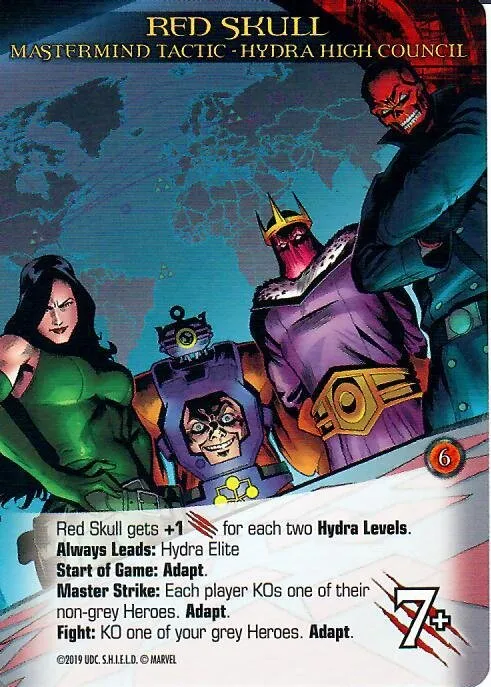
The Hydra High Council is a council mastermind — four members (Red Skull, Viper, Arnim Zola, Baron Helmut Zemo), each carrying its own Master Strike. The engine models a mastermind as one primary card plus its tactics, and a council does not fit that shape. Until recently it resolved to an empty placeholder — no Master Strike, no tactics, no abilities — so the match ran, looked normal, and had no opponent. Both S.H.I.E.L.D. masterminds were affected.
Rather than leave that silently broken, match setup now rejects it outright. A match that refuses to start is better than one that starts and means nothing.
What that means for you. The four schemes below are real, and they are still worth reading — they are ordinary S.H.I.E.L.D. schemes and you can play every one of them against a different mastermind today. What you cannot do is run them as this gauntlet, or post to this board, until councils are properly modelled. Tracked as WP-390 / D-24206.
If you want a gauntlet you can actually start right now, the Core Set Magneto gauntlet is the one to read next — it is a genuine test and it works.
The board
The block below is generated from the live gauntlet catalog. If a set changes, it changes here too.
| Mastermind | Hydra High Council |
| Set | S.H.I.E.L.D. — shld |
| Legs | 4 schemes |
| Board | gauntlet-shld-hydra-high-council (solo), …-p2 … …-p5 |
| Divisions | Open, Fixed-Pool |
The four legs:
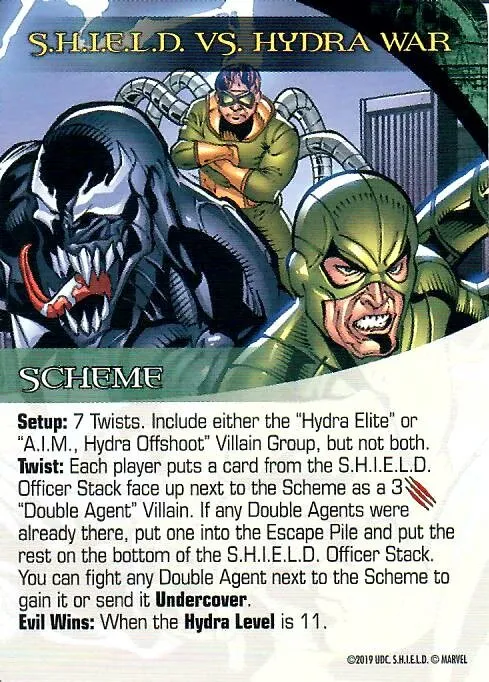
1. S.H.I.E.L.D. vs. HYDRA War
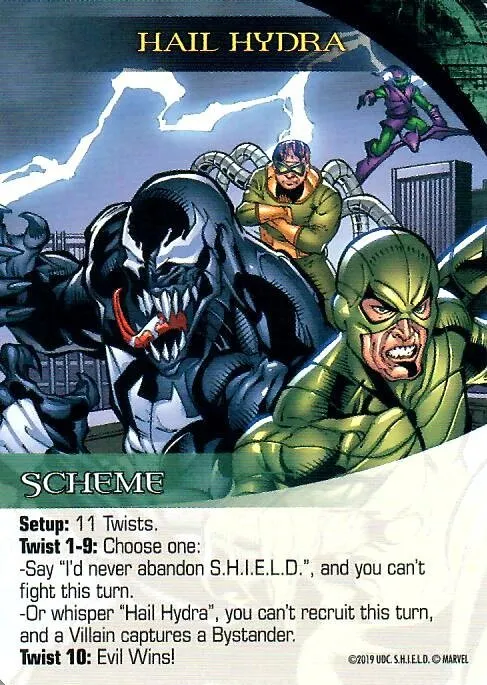
2. Hail Hydra
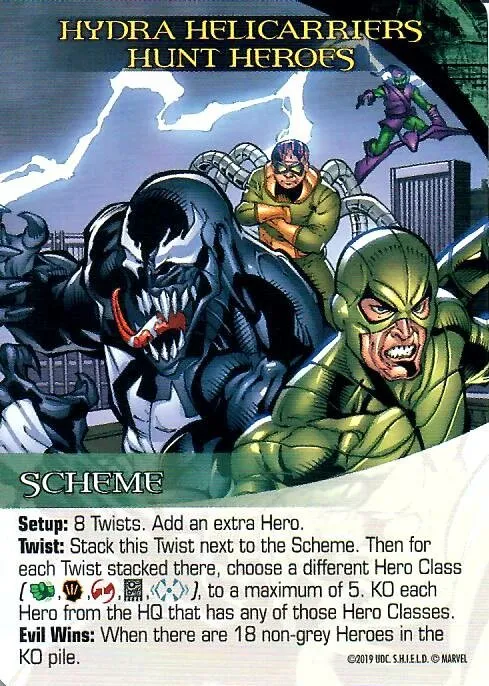
3. Hydra Helicarriers Hunt Heroes
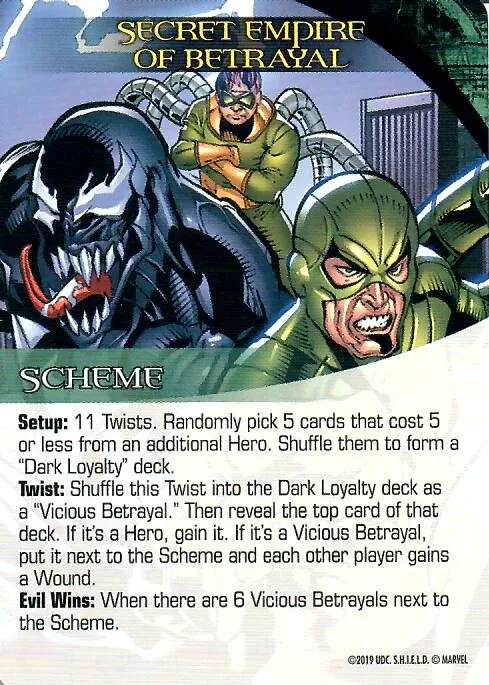
4. Secret Empire of Betrayal
Setup by player count — scores never compare across counts, so a solo run and a three-player run sit on separate boards:
| Players | Villain groups | Henchmen groups | Bystanders in villain deck | Heroes |
|---|---|---|---|---|
| 1 | 1 | 1 | 1 | 3 |
| 2 | 2 | 1 | 2 | 5 |
| 3 | 3 | 1 | 8 | 5 |
| 4 | 3 | 2 | 8 | 5 |
| 5 | 4 | 2 | 12 | 6 |
As always: the gauntlet fixes the mastermind and the four schemes, nothing else. Villain groups are entirely your choice — any villain groups qualify — and so are henchmen. Two runs at the same leg can look nothing alike.
Why four legs matters more than it sounds
A gauntlet entry requires a winning score on every leg. That completeness rule is what makes the format meaningful, and it is also what stops most people — not difficulty, attrition. A nine-leg gauntlet means nine separate evenings where nothing can go wrong permanently.
Four legs changes the arithmetic. It is a realistic single-sitting project at solo, or one session with a regular group. If you have been looking at the leaderboard thinking “someday,” this is the one where someday is a Saturday.
The other quiet advantage: best-per-leg scoring means retries only ever help you. A bad run at Hail Hydra costs you nothing but time — your best score stands. With four legs, the cost of experimenting is low enough that you can afford to learn the set properly rather than playing it safe.
What the schemes ask
Note the section title. This is deliberately about the schemes, not the mastermind — per the note above, the Council cannot currently be fielded at all, so everything below is about the schemes themselves and the villains you choose to face. It stays useful for playing these schemes under another mastermind.
The S.H.I.E.L.D. set is built around infiltration and betrayal as themes, and the schemes lean that way — Secret Empire of Betrayal and Hail Hydra both trade on the idea that your own side is compromised.
The practical read across all four legs: do not over-commit to a single line of play. Schemes in this set tend to punish the player who has arranged everything perfectly and has no answer when the arrangement is disrupted. A build with two ways to generate its resources will ride out a bad twist that a single-engine build will not.
Because the gauntlet leaves villain groups open, you also have a real lever here that people forget to pull: you choose what you fight. Villain-group selection is part of your run, not part of the fixture.
The Fixed-Pool division
Every board carries two divisions. Open is the normal one — any heroes, leg by leg. Fixed-Pool Championship is the prestige version: across all four legs, the union of every hero you used must fit inside heroCount + 2.
| Players | Heroes per match | Fixed-Pool budget |
|---|---|---|
| 1 | 3 | 5 |
| 2–4 | 5 | 7 |
| 5 | 6 | 8 |
Four legs is also the friendliest place to attempt Fixed-Pool, and it’s worth understanding why the budget is generous here rather than assuming it’s tight. At solo you get five heroes across four schemes — three per match, so two substitutions total. At two-to-four players, seven heroes across four schemes is genuinely comfortable.
That makes it a forgiving place to practise the Fixed-Pool constraint — the budget is real enough to be interesting and loose enough to survive, unlike the nine-leg sets where one mis-chosen core hero follows you all championship. Just be clear about what it does and doesn’t prove: with the Council inert, clearing this gauntlet tests your pool against four schemes, not against a mastermind. For a genuine Fixed-Pool test today, the Core Set Magneto gauntlet is the honest one.
Heroes
Worth stating plainly, because it is the most common wrong assumption about the format: your heroes are not restricted to the S.H.I.E.L.D. set. The gauntlet pins the mastermind and the four schemes. Heroes come from anywhere in your collection.
The set’s own twelve are thematically apt and a reasonable place to start — Agent Phil Coulson, Deathlok, Mockingbird, Quake, Dum Dum Dugan, Grant Ward, G.W. Bridge, Leo Fitz and Jemma Simmons, Melinda May, Sharon Carter, Victoria Hand, and Yo-Yo Rodriguez — but nothing stops a mixed roster, and in Open division there is no reason not to bring your best.
Suggested approach:
- Run the legs in the order above. S.H.I.E.L.D. vs. HYDRA War is the most straightforward introduction to the set’s pressure; Secret Empire of Betrayal is the one most likely to catch out a fragile build, so meet it once you know what you’re doing.
- In Open, counter-pick freely. There is no reason to handicap yourself; the division exists for exactly this.
- In Fixed-Pool, choose for floor rather than ceiling. With only four legs your core is exposed less often, but it’s still the same core every time.
What this section will say later
Being straight about it: the boards are new, so the guidance above is informed opinion, not measured results. Nobody has enough Hydra High Council data yet to say what actually wins this gauntlet.
Every score here is replay-verified, which means once entries accumulate we can publish the real thing — hero frequencies among ranked entries, actual Fixed-Pool compositions, per-leg score distributions. This section gets replaced with data rather than more opinion.
Four legs, and the schemes are worth learning on their own terms — under a mastermind you can actually field. Come back to this board when the Council is modelled.
One honest caveat before you start. The gauntlet boards are not accepting entries yet. Competitive scoring is gated on PAR calibration — the per-scenario baseline every score is measured against — and PAR is deliberately unpublished until the engine implements each scenario’s card abilities faithfully. Publishing baselines against a partly-implemented engine would bake wrong numbers into permanently version-pinned scores, so the gate stays closed on purpose.
Practically: you can play these matches today, but a finished run will not yet post to the board. When calibration publishes, the boards open. Four legs is still the cheapest gauntlet to learn, and learning it now is a head start rather than wasted effort.